
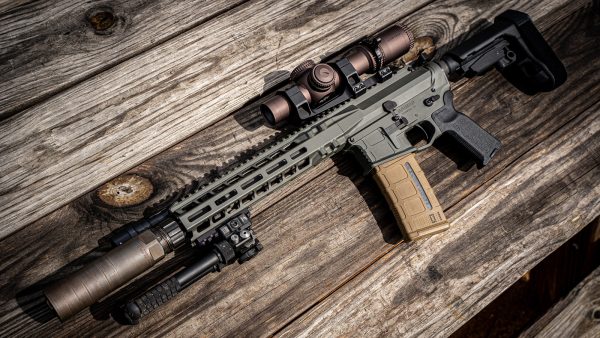

The fight over whether government officials can ban America’s most popular rifle is approaching a historic showdown at the U.S. Supreme Court. On Friday, November 20, 2026, gun-rights plaintiffs submitted their final reply brief in Viramontes v. Cook County and Grant v. Higgins, arguing that bans on AR-15s and similar semiautomatic rifles violate the Second Amendment under legal principles the Court has already established.
With oral arguments scheduled for December 2, the Second Amendment Foundation (SAF), Firearms Policy Coalition (FPC), and their fellow plaintiffs are making their final written case against Cook County’s and Connecticut’s so-called “assault weapons” bans. Their argument is straightforward: Firearms in common use by law-abiding Americans are protected by the Constitution, and government officials cannot simply declare those firearms too dangerous for ordinary citizens to own.
Perhaps the most significant point in the November 20 filing is that the plaintiffs are using the Supreme Court’s own words to make their case. In its unanimous 2025 decision in Smith & Wesson Brands, Inc. v. Estados Unidos Mexicanos, the Court described the AR-15 as “the most popular rifle in the country.” Now, the plaintiffs argue that such an acknowledgment leaves little room for Cook County and Connecticut to claim these rifles fall outside the Second Amendment’s protection.
Supreme Court Already Recognized the AR-15’s Popularity
The central question in these consolidated cases is whether the Second and Fourteenth Amendments protect the right to possess AR-15-platform rifles and similar semiautomatic firearms. The plaintiffs maintain that District of Columbia v. Heller already established the answer by recognizing that the government cannot categorically prohibit an entire class of arms commonly possessed for lawful purposes.
The November 20 reply argues that neither Cook County nor Connecticut has successfully disputed the widespread lawful ownership of these rifles. Instead, the governments have attempted to justify their restrictions by arguing that the firearms are unusually dangerous or insufficiently connected to individual self-defense.
But the plaintiffs point out that possessing a firearm for self-defense does not require someone to actually discharge it during a defensive encounter. Americans keep firearms available to protect themselves and their families, and the constitutional right does not disappear merely because a gun owner never needs to pull the trigger. The brief also emphasizes that lawful purposes extend beyond self-defense to hunting, firearms training, and other traditional activities.
This distinction matters because the Second Amendment protects the right to keep and bear arms, not merely the right to fire a gun after becoming the victim of a violent crime. Allowing the government to determine constitutional protection based on how frequently a particular firearm is discharged defensively would fundamentally misunderstand the right itself.
The plaintiffs also cite the Supreme Court’s 2025 Smith & Wesson decision, which recognized that AR-15s are widely available and purchased by ordinary consumers. Although that case involved Mexico’s lawsuit against American firearms manufacturers rather than the constitutionality of rifle bans, the Court’s description of the AR-15’s popularity provides substantial support for the plaintiffs’ common-use argument.
Cook County’s Dangerousness Test Would Revive Rejected Interest Balancing
Unable to seriously dispute the widespread ownership of AR-15s, Cook County and Connecticut have advanced a different approach to defending their bans. They argue that certain firearms can be prohibited based on whether they are especially dangerous and whether their characteristics are proportional to the purposes of self-defense.
The plaintiffs contend that this proposed test is little more than the same judicial interest balancing that the Supreme Court rejected in New York State Rifle & Pistol Association v. Bruen.
Under the governments’ approach, judges would once again be permitted to weigh a firearm’s perceived dangerousness against its defensive usefulness when determining whether the Second Amendment protects it. That would give courts considerable discretion to decide which commonly owned firearms Americans should be allowed to possess, rather than requiring the government to establish that its restrictions are consistent with the nation’s historical tradition of firearm regulation.
The reply argues that this framework closely resembles the means-end scrutiny federal appellate courts previously used to uphold gun-control laws before Bruen. The plaintiffs also draw parallels between the governments’ arguments and Justice Stephen Breyer’s dissent in Heller, which favored balancing the costs and benefits of firearm restrictions.
That is precisely the constitutional problem the plaintiffs are asking the Supreme Court to confront. If government officials can declare a commonly owned firearm unusually dangerous and then use that designation to justify prohibition, the common-use protection recognized in Heller becomes vulnerable to the preferences of whichever judges happen to hear a case.
The plaintiffs also challenge the historical examples offered by Cook County and Connecticut, including restrictions involving Bowie knives, English weapons proclamations, and early twentieth-century firearms laws. They argue that these examples do not establish a historical tradition of banning ordinary firearms commonly possessed by law-abiding citizens.
Government Targets Ordinary Rifle Features While Ignoring How Firearms Work
One of the more revealing portions of the reply addresses the features governments use to classify semiautomatic rifles as prohibited “assault weapons.”
Cook County and Connecticut regulate firearms based partly on their configurations, including grips, stocks, and other ordinary rifle components. The plaintiffs argue that these features improve usability, adaptability, and accuracy, which help explain why AR-15-pattern rifles have become so popular among American gun owners.
The brief also addresses the familiar gun-control term “barrel shroud.” Connecticut acknowledges that these components protect firearm operators from the heat generated during repeated firing, a practical safety benefit that any experienced rifle owner should understand.
The absurdity of treating ordinary ergonomic and safety features as grounds for prohibition is difficult to overlook. A pistol grip does not transform a semiautomatic rifle into a machine gun, and a handguard that protects the operator from a hot barrel does not somehow erase the firearm’s constitutional protection.
The plaintiffs further distinguish semiautomatic AR-15s from fully automatic military firearms, noting that the two have different operating characteristics and capabilities. Their argument challenges the recurring attempt to conflate commonly owned civilian rifles with automatic military weapons simply because the firearms may share a similar appearance.
These distinctions are particularly important because the bans do not directly regulate characteristics such as muzzle velocity or ammunition. Instead, they frequently determine legality through combinations of ordinary features that make firearms comfortable, adaptable, and practical for lawful ownership.
SAF Says the Supreme Court Does Not Need to Break New Ground
The Second Amendment Foundation, which is participating in both cases, welcomed the reply brief and emphasized that the Court does not need to invent a new constitutional standard to strike down the challenged restrictions.
In a November 20 statement, SAF Executive Director Adam Kraut said the organization believes the Court’s existing Second Amendment precedents already resolve the central constitutional question.
“The analysis the Supreme Court has to do to conclude these laws are unconstitutional has already been decided,” Kraut said. He argued that Cook County and Connecticut have attempted to reinterpret established constitutional protections rather than apply them as written.
SAF founder and Executive Vice President Alan M. Gottlieb also emphasized the importance of preparing for two consolidated challenges involving separate governments and different firearm restrictions. The organization is joined in Viramontes by FPC and individual plaintiffs, while its partners in Grant include the Connecticut Citizens Defense League and individual plaintiffs.
The constitutional principle at stake extends far beyond Illinois and Connecticut. A ruling establishing that commonly owned semiautomatic rifles cannot be categorically banned under Heller would have major implications for similar prohibitions elsewhere in the country.
Cook County’s Attempt to Dismiss the Case Remains Unresolved
While the merits briefing has concluded, a separate procedural dispute continues to hang over Viramontes v. Cook County.
On November 5, Cook County submitted a suggestion of mootness following lead plaintiff Cutberto Viramontes’s request to withdraw from the litigation. The county argues that his withdrawal would undermine the remaining plaintiffs’ standing and warrant dismissal of the case.
The plaintiffs responded on November 11, arguing that a live constitutional controversy remains. Their filing discusses fellow plaintiff Christopher Khaya’s interest in possessing an IMI Galil and an AR-15, along with a declaration from SAF and FPC member Ed Smolen concerning his desire to possess an AR-15 at his Cook County residence.
Cook County disputed those arguments in its November 13 reply, maintaining that the remaining plaintiffs have not established sufficient grounds for the Court to continue reviewing the case. According to the Supreme Court docket, neither the withdrawal request nor the county’s mootness challenge had been resolved as of November 20.
However, even if the Court dismisses Viramontes, the consolidated Connecticut case, Grant v. Higgins, remains before the justices. Both sides have acknowledged that the procedural dispute involving Cook County does not affect the Court’s ability to address the constitutional question through Grant.
December 2 Could Reshape the Fight Against AR-15 Bans
The Supreme Court will hear consolidated oral arguments in Viramontes v. Cook County, No. 25-238, and Grant v. Higgins, No. 25-566, on Wednesday, December 2, 2026. The Court has also granted the United States Solicitor General permission to participate in oral arguments supporting the petitioners’ side.
For millions of American gun owners, the stakes could hardly be higher. The justices will have an opportunity to address whether governments may categorically prohibit rifles that are overwhelmingly familiar to lawful gun owners, widely possessed throughout the country, and plainly within the ordinary understanding of bearable arms.
The plaintiffs’ final brief asks the Court to enforce the constitutional protections it recognized in Heller and reaffirmed in Bruen, rather than allowing states and local governments to substitute their own judgments about which firearms citizens should possess.
The Second Amendment does not grant Cook County, Connecticut, or any other government the authority to decide that an otherwise protected firearm becomes unacceptable simply because politicians dislike its features or popularity. That is the fundamental principle the plaintiffs are asking the Supreme Court to enforce.
With the Court itself having recognized the AR-15 as America’s most popular rifle, the question now is whether the justices will apply the common-use standard to the very firearms that gun-control advocates have spent decades attempting to prohibit.
AmmoLand will continue following developments in both cases, including any ruling on Cook County’s pending dismissal request and the December 2 oral arguments. Readers can follow our continuing coverage through the AmmoLand 2A NewsRoom.
About Duncan Johnson:
Duncan Johnson is a lifelong firearms enthusiast and unwavering defender of the Second Amendment—where “shall not be infringed” means exactly what it says. A graduate of George Mason University, he enjoys competing in local USPSA and multi-gun competitions whenever he’s not covering the latest in gun rights and firearm policy. Duncan is a regular contributor and editor-in-chief for AmmoLand News and is responsible for AmmoLand’s daily gun-rights reporting and industry coverage.