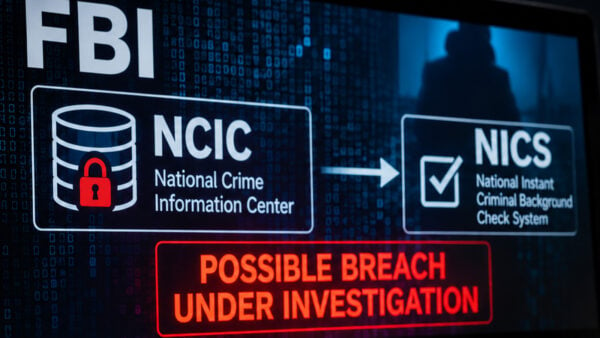

The FBI is investigating an apparent hack of the National Crime Information Center (NCIC), the nationwide crime database that feeds the National Instant Criminal Background Check System (NICS) on every firearm background check.
NCIC is the system law enforcement uses to share warrants and other criminal justice records. Official FBI documents say NICS queries NCIC, along with two other federal databases, every time a licensed dealer runs a gun check. That is why a reported breach of NCIC matters to anyone who buys a gun from a licensed dealer.
What officials have said so far
CNN first reported the breach on Friday evening, Nov. 20, 2026, citing two people briefed on the investigation, that the FBI is investigating an apparent breach of NCIC. CNN said the intrusion was discovered in recent days and that bureau officials had learned of the incident by Thursday. CNN described NCIC as a nationwide database used to share information on warrants and background checks, and called the incident the second such breach in recent months.
NBC News independently reported the same Friday night, also citing two people briefed on the matter. NBC News said the FBI had no comment as of Friday night.
On Saturday, The Associated Press reported that a person familiar with the matter said the FBI is investigating an apparent hack of the national law enforcement database it maintains.
The FBI has made no public statement confirming the incident, naming a suspect, or describing what, if anything, was accessed. It remains unclear when the breach occurred, how attackers gained access, or whether any information was stolen, and that there is no indication the NCIC incident is connected to an earlier FBI jobs-site breach.
AmmoLand News has been able to verify FBI IT teams are still investing if anything has been added, changed, or deleted from the database by comparing data from before the compromise and after the compromise
How NCIC feeds NICS
The FBI’s Criminal Justice Information Services Division maintains NCIC, which the bureau calls “the lifeline of law enforcement.” The same division “provid[es] eligibility determinations for sale and transfer of firearms through the National Instant Criminal Background Check System.”
The FBI’s NICS Section 2024 Operational Report is explicit. “Every NICS check consists of either the FBI or a POC state agency comparing the descriptive information provided by the individual against three national databases: Interstate Identification Index (III), National Crime Information Center (NCIC), and the NICS Indices.”
The 2024 report says NCIC’s person files are checked for possible descriptive matches to “records of wanted persons, subjects of disqualifying protection orders, and other persons who pose a threat to public and officer safety.” The FBI’s NICS overview brochure likewise describes NCIC as containing “information on wanted persons and protection orders.”
The 2024 report also says information in those databases “is modified, cancelled, and added daily,” and that “it is vitally important that information needed to determine firearm eligibility is available to NICS in one or more of these three databases.” NICS “depends on the availability of the NICS Indices, III, and NCIC.” If NCIC is not available, “it impacts NICS even though NICS and the NICS Indices are fully operational.” NCIC responses “may include firearm disqualification indicators” that can speed a denial. The FBI’s NCIC page says the system, as of 2023, had 22 files with more than 18 million active records and averages millions of transactions each day.
What NICS and NCIC hold about gun buyers
A NICS check starts with information from ATF Form 4473, including the prospective buyer’s name and descriptive data such as date of birth, sex, race, state of residence, and country of citizenship, according to the 2024 report.
The NICS Indices are not a list of lawful gun owners. They are a file of people already identified as prohibited. As of Dec. 31, 2024, the FBI reported 33,025,815 active NICS Indices entries “identifying prohibited individuals.”
The NICS Audit Log captures every background check. What stays in that log depends on the outcome, under rules meant to keep NICS from becoming a registry of lawful buyers.
For a transaction that is allowed to proceed, federal rules require the destruction of identifying information submitted by or on behalf of the transferee within 24 hours after the dealer is told the transfer may proceed. That requirement comes from the Brady Handgun Violence Prevention Act, 18 U.S.C. § 922(t)(2)(C), and Public Law 112-55, Section 511 and is implemented in 28 C.F.R. § 25.9. The FBI’s privacy assessment says that after that first purge, the Audit Log retains the NICS Transaction Number (NTN), the date and time of the transaction, status, and limited non-identifying details, and that a second purge, usually by the 88th day, leaves only the NTN and the date of the transaction.
Denied transactions are treated differently. The privacy assessment says all information in the Audit Log for denied transactions is retained, and that “information on denied transactions is pushed to the NCIC’s NICS Denied Transaction File,” where it is available to federal, state, local, tribal, and territorial criminal justice agencies.
If a check is neither proceeded nor denied by the 88th day, identifying information is purged and only the NTN and the date remain. The 2024 report cites the same regulation in saying that if an eligibility determination cannot be made, all information relating to the check, except the NTN and the date of inquiry, is destroyed after not more than 90 days.
Why gun owners should be worried
Government databases tied to gun checks are a target. This is the second such breach in recent months. In September, a group calling itself ShinyHunters targeted an FBI jobs website and went after employee personal data. On Oct. 6, 2026, FBI Cyber Division Assistant Director Brett Leatherman said in a statement reported by NBC News that the jobs-site incident “occurred as the result of a security failure of a platform managed by a third-party organization,” andon’d a contractor “failed to implement a security patch explicitly issued to secure the platform.” ShinyHunters is not believed to be tied to this hack.
The second reason is the integrity of the records NICS uses. A lawful buyer can be delayed or denied if NCIC returns a bad match to a warrant or a protection order. The FBI’s own NICS report says timely, accurate information in these databases is “vitally important” to an eligibility decision. None of that is proof that records were altered in this incident. It is why a reported breach of the database that feeds NICS is not a problem only for police agencies.
The third reason is privacy. Gun owners have long opposed a national gun registry. Congress required the 24-hour destruction of identifying information on approved transfers for that reason. Even under those rules, the government still retains full audit information on denied transactions and places denial data into an NCIC file. NCIC also holds warrants, protection orders, and other criminal justice records that can follow a person for years. If hackers can get into the crime database that NICS queries on every gun sale, then databases connected to firearm background checks are a high-value target.
About John Crump
Mr. Crump is an NRA instructor and constitutional activist with more than 26 years of experience in networking and cybersecurity for major Fortune 100 companies. John has written about firearms, the Constitution, and cybersecurity, and has interviewed people from all walks of life. John lives in Northern Virginia with his wife and sons. Follow him on X at @right2bear, or at www.crumpy.com.