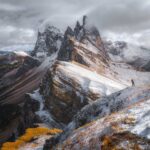
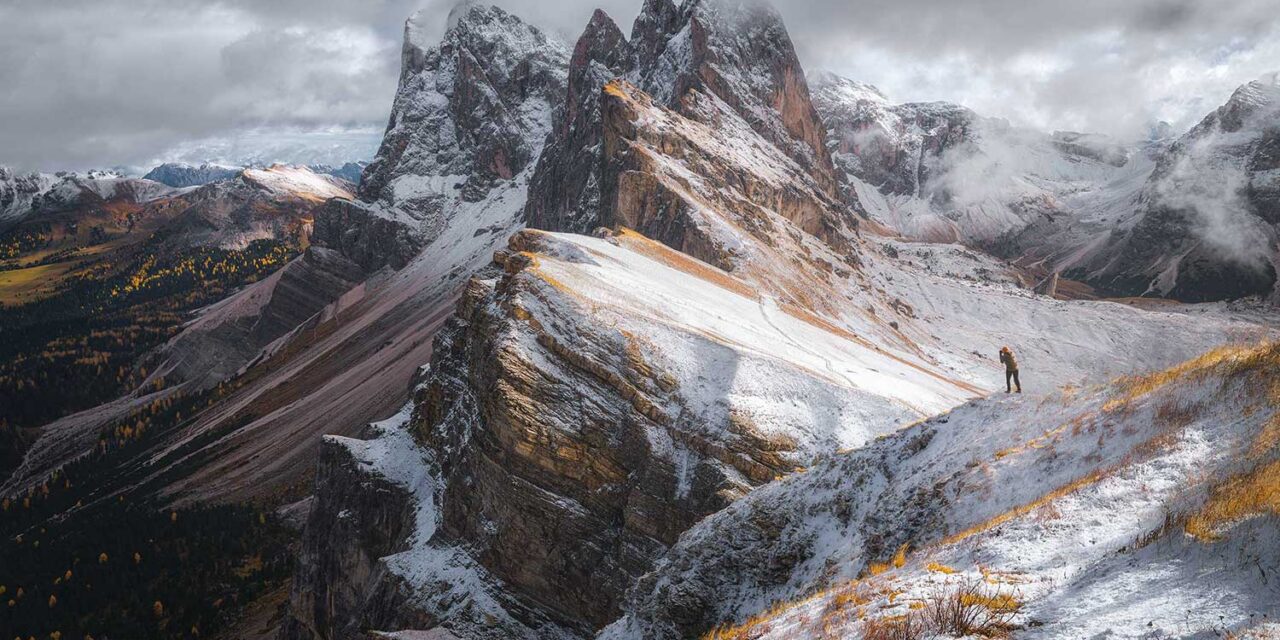

When seasons collide in the Italian Dolomites. Fujifilm GFX 100S, Fujifilm GF 32-64mm f/4 R LM WR. Exposure: 1/60 sec., f/16, ISO 100.
Eight years ago, after 17 years in the corporate world, Mark Denney was laid off. Rather than look for another office job, he saw an opportunity to pursue a longtime dream: becoming a full-time photographer.
It was a gamble that paid off. Today, Denney has built a thriving photography business centered on international workshops, online education and a popular YouTube channel. His combined audience across YouTube and his newsletter numbers more than 350,000.
Drawing on the marketing experience from his previous career, Denney has developed a successful business around his passion for landscape photography. Along the way, he’s also established a distinctive photographic style characterized by simplicity, subtle colors and an almost painterly quality.
We caught up with Denney to discuss his transition from corporate life to professional photography, how he makes a living as a landscape photographer, and the creative principles that guide his work.
See how this story appears in the magazine: Outdoor Photographer Vol. 1 (Digital Edition)
Outdoor Photographer: What prompted you to pivot from business to art?
Mark Denney: It’s so funny how life works because, looking back on it, being laid off was probably one of the best things that’s ever happened to me. I know that sounds so cliché, but it legitimately was. It took my life and put it on a completely different trajectory.
I made a roll of the dice and said, “You know what, I’ve been in the corporate world pretty much my adult life. Let’s spend 12 months and see if I can make photography work.” The first quarter I made $300 or $400; the first year I made something like $12,000. Thankfully, that 12-month experiment has now turned into eight years, and everything keeps humming along. It’s been quite the wild run, that’s for sure.
OP: Why did you choose to focus on landscape photography?
MD: When I was first laid off, I was doing what I felt most working photographers do: You do portraits, maybe a wedding, maybe event photography or real estate photography. I literally offered everything. And I got a lot of jobs! I just didn’t enjoy any of it.
I wasn’t excited about it. I remember taking portraits and becoming so anxious and nervous. I didn’t feel comfortable telling people how to pose. I knew my job was to make the model feel at ease, but I remember thinking, how am I supposed to do that when I’m an absolute nervous wreck?
I remember so vividly the day it happened. I thought, Mark, why don’t you just photograph what you like to do?
You don’t have to tell a mountain to point its chin toward the sky or roll its shoulders back. I found that landscapes were just so relaxing. The problem was, where do you make money with landscape photography? That was the hard part, which is where the teaching side of it came in.

The cathedral of trees in the Great Smoky Mountains. Nikon Z8, NIKKOR Z 14-24mm f/2.8 S. Exposure: 1/4 sec., f/11, ISO 200.
OP: It sounds like a dream job, but maybe one that’s becoming more difficult?
MD: I’ve spent eight years figuring it out. Most working landscape photographers are also amazing teachers. It doesn’t have to be YouTube. Actually, most of the time it’s not YouTube. But it’s almost always workshops, conventions, speaking engagements, podcasts or writing articles. It’s all predicated around education and inspiration, just getting people outside to photograph beautiful Earth.
OP: How much of your time is spent doing YouTube versus being outdoors?
MD: The last few years I’ve been running a maximum of 10 workshops, and all are a minimum of seven to 10 days. So right there is 70-plus days in the field. I usually arrive a few days early just to see the locations we’re taking the groups to, and then I’ll always stay a few days afterward as long as the schedule allows. There’s probably not as much personal time in the field as I would like, but maybe an additional 30 to 40 days just for me. So, roughly 100 days of the year.
The rest of the time, unfortunately, I’m behind a desk. That’s the YouTube and email newsletter side of the business, which has exploded over the last two years.

Fire in the sky at Schwabacher Landing, Grand Teton National Park. Nikon Z8, NIKKOR Z 14-24mm f/2.8 S. Exposure: 1/250 sec., f/11, ISO 100.
OP: You share a lot of wonderful photography tips on your channels. I’m curious about some that have helped you personally.
MD: I see photographers all the time on workshops. We get to this absolutely gorgeous scene, and we’re all standing there. A lot of people don’t have any idea how to photograph it. Everything they see is absolutely gorgeous, so knowing where to put your camera and how to compose an image can be really difficult when there’s so much amazingness.
Something that has really helped me — and I didn’t coin this term — is that photography is an exclusionary art. What you exclude from an image is just as important as what you include. I really took that to heart, and I’m always thinking about it. What are the things that are going to make it into the frame, and what are the things that are going to be relegated to the sidelines?
Ultimately, that’s helped me simplify, simplify, simplify. Keep it easy on the eyes.
I have plenty of photos that feature a big, explosive sunrise or a very chaotic foreground. And I personally don’t think those images are very comfortable to look at. They create visual tension, which I also think is good, but I really enjoy trying to create an attractive photograph that’s easy for people to look at.
I think simplifying things is a beautiful way to do that. Just keep it simple. But in landscapes, that’s kind of hard because there’s so much going on. That’s something I’m always thinking about: What are you going to exclude?
The stuff that works on social media is the big, explosive sunrises and sunsets. Those things garner a lot of attention, but most people usually don’t want that in their home. And to me, those usually aren’t the most relaxing photographs to look at.
I actually just posted a brand-new photo from the Smokies. It’s a beautiful overarching tree with some nice spring green and a blanket of fog behind it. No, it’s not going to garner a ton of social media love, but for me, it’s an absolutely gorgeous, quiet, simple, easy-on-the-eyes photograph that my wife already wants to print and hang on the wall. Because it’s just such a peaceful photograph. That’s what I really, really like.

Titanic sea stack glowing in Olympic National Park. Fujifilm GFX 100S, Fujifilm GF 20-35mm f/4 R WR. Exposure: 1/15 sec., f/16, ISO 100.
OP: Does simplicity translate to your equipment choices, too?
MD: I was using Fujifilm for six years. A few of the photos here were captured with the GFX 100S, which is absolutely gorgeous. But I switched to Nikon about a year and a half ago, to the Z8. There were a lot of depth-of-field challenges with medium format, and I felt that a full-frame camera would alleviate some of those. It definitely did.
I was having to focus-stack so many things with the medium-format camera, and I didn’t really enjoy doing that. I felt like the technology was getting in my way because I was having to think about it all the time. But with full frame, I really never think about that anymore.
I’m always trying to get the equipment out of my way. I want to focus on the artistic side of it all. The less you think about equipment, the better.
I’ve used NiSi filters since day one. It feels really good to become an ambassador for a brand you really enjoy. The only filter I consistently use is a polarizer. If you look through my photos, I don’t have many photographs with five-second exposures or even one-second exposures.
When I photograph water, I’m usually trying to show that the water is moving while retaining as much detail as possible. The only way to really achieve that is to use a shutter speed of around 1/15 or 1/25 sec. Usually, you can drag the shutter that long just by applying certain camera settings. You don’t really need a filter to do that.
So I don’t use neutral-density filters much, but I use a polarizer a lot. On almost all the seascapes, it’s pretty standard operating procedure.

Dancing Sumba trees off the coast of Sumba in Indonesia. Fujifilm GFX 100S, Fujifilm GF 20-35mm f/4 R WR. Exposure: 1/5 sec., f/8 ISO 400.
OP: Do you have a favorite lens?
MD: Lately, it’s been the Nikon 24-120mm. I think it’s such a versatile lens because it’s on the longer edge of a midrange lens.
I love telephoto photography. I love the simplicity of it because the farther you go out, your area to work with is drastically reduced. I find long-lens photography very relaxing because you don’t have so many things to account for in your frame. It’s a beautiful way to keep things simple, which I really enjoy.
The image of the tree in the Smokies was made with that 24-120mm, zoomed all the way out to 120mm. I think it’s great. It’s such a simple image.

Meandering through a golden grove of aspens in the San Juan Mountains of Colorado.
Fujifilm GFX 100S, Fujifilm GF 20-35mm f/4 R WR. Exposure: 1/60 sec., f/16, ISO 200.
OP: Is your post-processing simple, too?
MD: People ask me all the time, “Is that a photograph or is that a painting?” And that’s the ultimate compliment because, although I’ve never shot film, I grew up with film, and I do like the way film looks better than digital. To me, the blacks in digital are so deep. Digital is so sharp. It has such high resolution. It’s so refined that photos almost feel kind of crunchy, almost lifeless a little bit.
So I actually edit my photos more toward a filmic style. Instead of sharpening everything, I take clarity out of almost all my photos. I’m purposely trying to soften them. I also lift the blacks a little bit, so I don’t have a true black point in any of my photos. The shadows are always kind of faded and a little softer. To me, it makes the photo feel a little more ethereal, a little more whimsical and a little more like film.
When I started doing that, somebody sent me an email and said, “Every time I see one of your photos, I know it’s yours before I even see your name.” I was like, oh, that’s the greatest compliment!
It changes and evolves over time, of course, but every year that goes by, I just love that look more and more.

Reflecting on the beauty of the Dolomites. Fujifilm GFX 100S, Fujifilm GF 20-35mm f/4 R WR. Exposure: 1/15 sec., f/16, ISO 100.
OP: Where are some of your favorite places to photograph?
MD: One of my favorite places I’ve been in the last few years is Bali. Really, all over Indonesia. Bali and the Indonesian coast are mesmerizing, just absolutely gorgeous.
I do a workshop in the Lofoten Islands in Norway to chase the northern lights in January, which is always a lot of fun. And I live in North Carolina, so I’ve been able to visit the Blue Ridge Mountains and the Smoky Mountains more than almost any other location.
I just got back from two workshops in the Smokies over the last couple of weeks. That’s where I cut my teeth in landscape photography, chasing waterfalls and photographing trees. That’s where I really fell in love with that stuff.

An otherworldly stroll through the Highlands of Iceland. Nikon Z8, Nikon Z 24-120mm f/4 S. Exposure: 1/60 sec., f/11, ISO 640.
OP: Is there a destination you’re most looking forward to photographing?
MD: I’m putting together a trip to New Zealand in December 2026, which I’m very excited about. Also Namibia next year, which I’ve never been to. And in January 2027, I’m going to Hokkaido, Japan, which I’m very excited about. Those are all probably at the top of the list for me. I’m very excited about all of them.
See more of Mark Denney’s landscape photography at markdenneyphotography.com.
Subscribe to Outdoor Photographer.
The post Mark Denney: From Corporate Layoff to Landscape Photographer appeared first on Outdoor Photographer.